

Summer Tyres
Summer tyres are made for warm conditions: their compound grips best when temperatures stay well above freezing. Choose the size and load index to match your car, and compare wet grip and noise on the EU tyre label. Below you will also find when Finnish rules let you switch to summer tyres and when to replace them. Read the guide
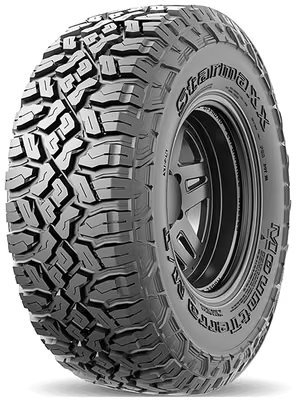


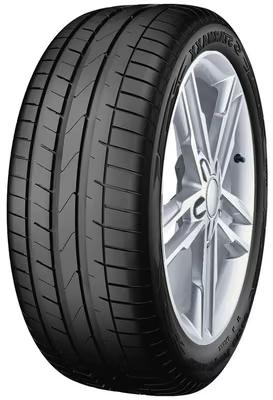
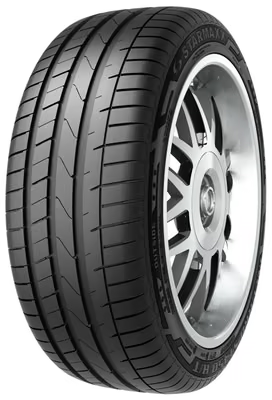
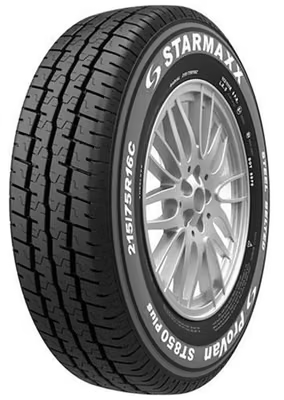

When you can switch to summer tyres
The Road Traffic Act sets no fixed date for summer tyres. Winter tyres are required from November to March only if weather or road conditions call for them, and there is no such obligation in other months. Studded tyres may be used until the end of March, and after that if conditions require. In practice, switch according to the conditions rather than the calendar: once night frosts are over and roads stay free of ice. Avoid wearing out winter tyres in summer: the soft compound wears quickly on warm tarmac and braking distances get longer. Timing varies a lot between southern and northern Finland – see our guide to changing tyres.
What to look for
- Wet grip – the EU label class A–E is often the most useful comparison for summer tyres, as rainy days are common in summer too.
- Aquaplaning – the main grooves channel water away from under the tyre; the shallower they wear, the more easily the tyre aquaplanes.
- Noise – the decibel value and class A–C on the label measure external rolling noise, i.e. how loud the tyre is outside the car. They do not directly tell you how quiet it is in the cabin.
- Rolling resistance – the fuel efficiency class affects consumption and an electric car's range.
- Load index and speed rating – at least what the car manufacturer requires. Heavy cars and electric cars may need XL tyres; see load markings.
Tread depth: law and recommendation
Legal minimum: the main grooves of car tyres must be at least 1.6 mm deep.
Recommendation: according to Traficom, summer tyres should have at least 4 mm of tread, especially to avoid aquaplaning. Measure the depth at several points across the tyre, as incorrect pressure or wheel alignment causes uneven wear. The tread wear indicators at the bottom of the main grooves mark the 1.6 mm limit. Also check the age and condition of your tyres – a tyre with cracks or bulges should be replaced whatever its tread depth.
All-season tyres in summer
All-season tyres save you the seasonal changeover, but in summer they usually fall short of summer tyres in wet grip, steering precision and wear resistance. If you drive a lot on main roads in summer, the advantage of summer tyres is clear.