

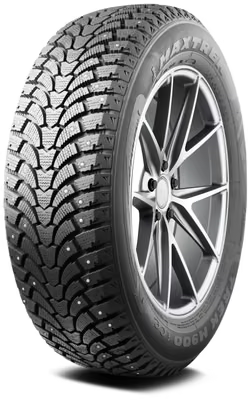
Studded Tyres
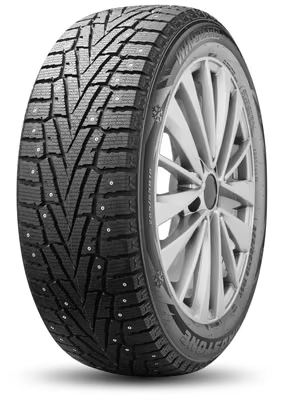
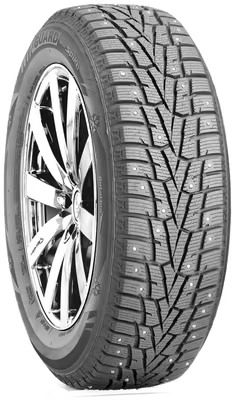
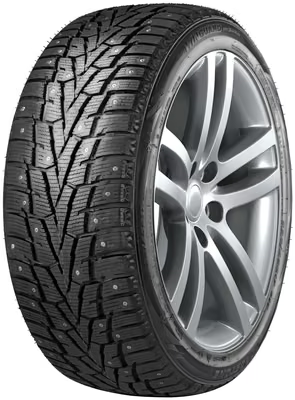
Studded tyres give better grip on bare and polished ice than non-studded winter tyres. In Finland they may be used from the start of November to the end of March, and at other times if weather or road conditions require it. On cars and vans, studded tyres must be fitted on all wheels. Read the guide


 M+S
M+S

 M+S
M+S
M+S
M+S
 M+S
M+S
M+S
M+S
M+S
M+S
M+S
M+S
M+S
M+S
M+S
M+S
M+S
M+S
 M+S
M+S
 M+S
M+S
M+S
M+S
M+S
M+S
M+S
M+S
M+S
M+S
M+S
M+S
M+S
M+S
M+S
M+S
M+S
M+S
M+S
M+S
M+S
M+S
M+S
M+S
M+S
M+S
When studded tyres are allowed
Under section 106 of the Road Traffic Act (729/2018), studded tyres may be used from the start of November to the end of March. At other times they are allowed if weather or road conditions require it – for example when it snows in October or roads are icy in April. There is no longer a fixed Easter rule. Studded tyres count as winter tyres even without the 3PMSF marking. We recommend taking studded tyres off in spring as soon as the weather has turned warm for good.
Other rules for studded tyres
- On cars, vans, special-purpose vehicles and trailers up to 3.5 tonnes, studded tyres must be fitted on all wheels. Studded and friction tyres therefore cannot be mixed.
- The number of studs may not differ between tyres in a way that causes danger.
- If the towing vehicle has studded tyres, a trailer of over 0.75 and up to 3.5 tonnes must have winter tyres.
- Traffic sign C48 can ban driving with studded tyres on a particular street or road.
- From November to March, whenever conditions require winter tyres, the main grooves of studded tyres must also be at least 3.0 mm deep (section 105).
Who studded tyres suit
Studs help most when your route often has bare or polished ice: on back roads and in rural areas, on hills and at junctions, and in regions where thaws and frosts alternate. They also help drivers who often set off early in the morning, before roads have been ploughed and gritted. Grip also depends on the condition of the studs: worn or missing studs reduce grip on ice, so check them before every winter.
Drawbacks of studded tyres
- Noise – on bare tarmac, studded tyres are noticeably louder than friction tyres.
- Road wear – studs wear down the road surface and increase street dust.
- Dry and wet tarmac – on clear roads studs bring no advantage; grip depends on the compound and tread.
- EU tyre label – studded tyres do not have one, so comparisons rely on product details and tests.
If you mostly drive on ploughed streets and main roads, consider friction tyres. More on use and choice: studded tyres in Finland.