

All-Season Tyres
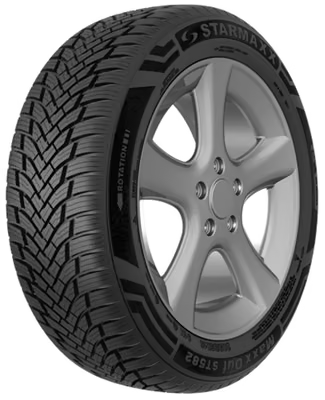
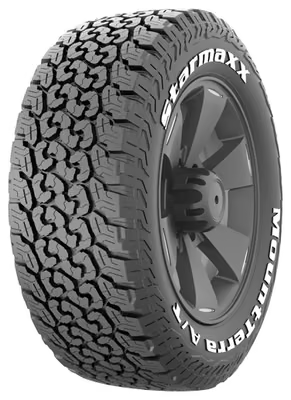
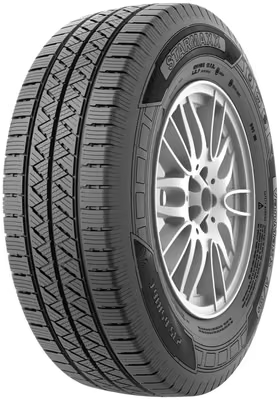
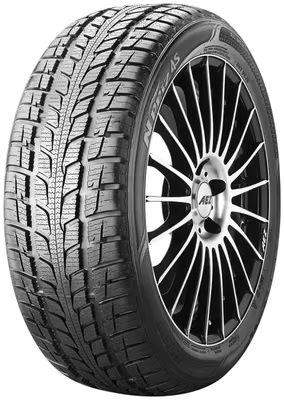
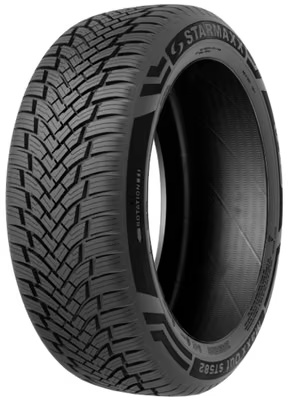
All-season tyres are a compromise between summer and winter tyres: one set with no seasonal changeovers. In Finland they count as winter tyres only if the sidewall carries the 3PMSF marking. They suit drivers who cover few kilometres a year, mostly in town, in areas with mild winters such as the south coast. Read the guide


 M+S
M+S
M+S
M+S
M+S
M+S
M+S
M+S
M+S
M+S
 M+S
M+S
M+S
M+S
M+S
M+S
 M+S
M+S
M+S
M+S
M+S
M+S
M+S
M+S
M+S
M+S
 M+S
M+S
M+S
M+S
M+S
M+S
 M+S
M+S
M+S
M+S
M+S
M+S
M+S
M+S
M+S
M+S
M+S
M+S
M+S
M+S
M+S
M+S
Who all-season tyres suit
- Short annual distances – with few kilometres a year, the compromise costs you little, and you avoid changing and storing a second set.
- City driving – on ploughed and salted streets an all-season tyre is usually enough.
- Areas with mild winters – on the south coast, winters are shorter and snow and ice less frequent than inland and in the north.
If you drive a lot on main roads and back roads or in eastern and northern Finland, proper winter tyres are the safer choice, as they grip clearly better on ice and packed snow.
Winter use under Finnish rules
From November to March, winter tyres must be used whenever weather or road conditions require it. Under Traficom's regulation, an all-season tyre counts as a winter tyre only with the 3PMSF marking (a three-peak mountain with a snowflake). M+S alone is no longer enough as of 1 December 2024: without 3PMSF, an all-season tyre may not be used in wintry conditions between November and March. The main grooves must then be at least 3.0 mm deep. Tyres on the same axle must be identical, so all-season and winter tyres cannot be combined on one axle. Check the marking in the product details before you buy, and read more in our 3PMSF guide.
Weaknesses of all-season tyres
- On ice, all-season tyres fall clearly behind Nordic friction and studded tyres, and they normally carry no ice grip symbol.
- In summer heat the compound is softer than a summer tyre's: braking distances can be longer and wear faster.
- Because the tyres stay on all year, check tread depth and age regularly – at least 3.0 mm is required in wintry conditions from November to March.
- Models differ a lot, so compare the wet grip and noise classes on the EU label just as you would for summer tyres.
When two sets are better
If your winters bring snow and ice, choose winter tyres – studded or non-studded. If you drive a lot in summer and want the best possible wet grip and steering feel, summer tyres are the right choice for the warm season.